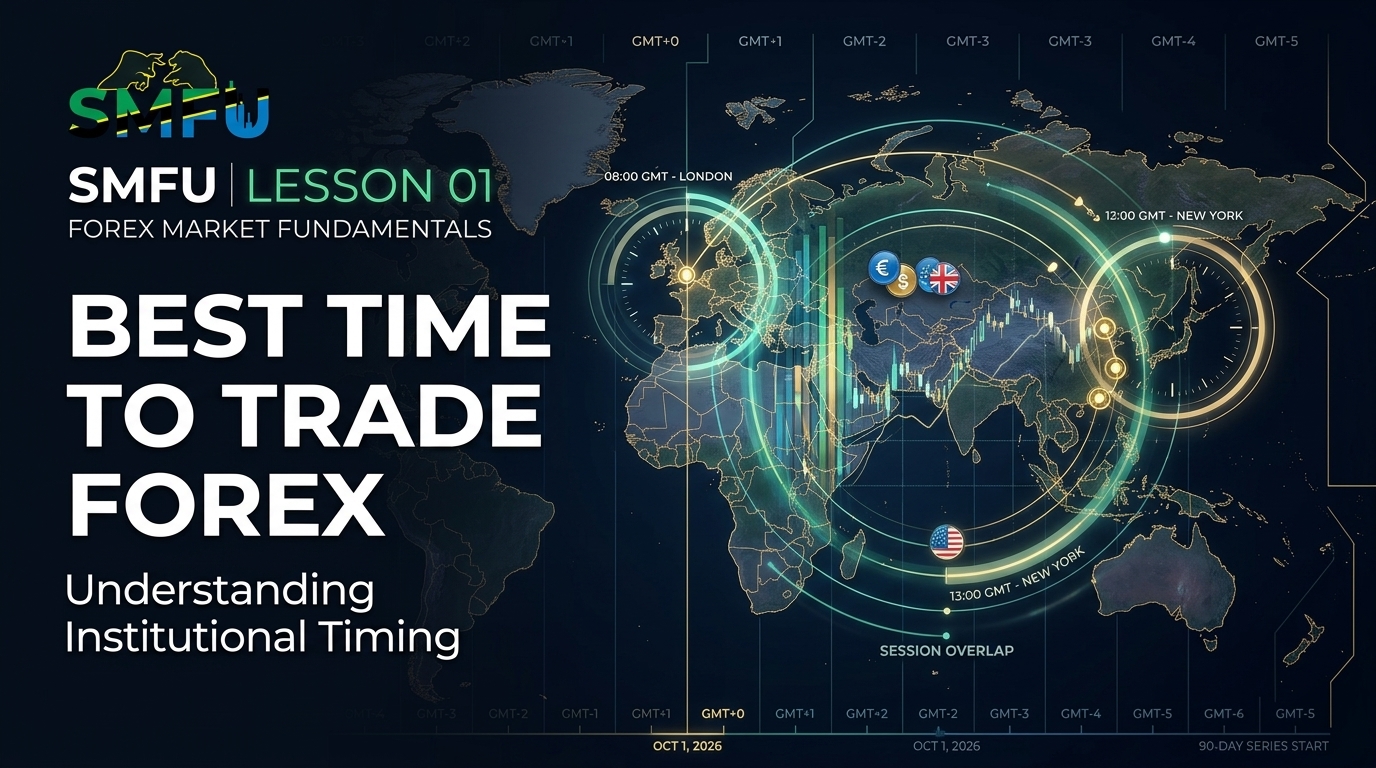
Best Time to Trade Forex: Understanding Institutional Timing
Introduction
One of the most common questions asked by new Forex traders is: “What is the best time to trade Forex?”
The answer is not simply a particular hour on the clock.
Forex is a global financial market that operates across different time zones, with major financial centres becoming active at different periods of the day. As these centres open and overlap, the level of market activity, liquidity and volatility can change.
Understanding these changes can help traders make more informed decisions about when to study the market, monitor opportunities and execute their trading plans.
The important point is that there is no single trading time that is best for everyone. The appropriate trading window depends on the currency pair, trading strategy, market conditions, personal schedule and risk management rules.
This article explains how market timing works and why understanding institutional activity is important when studying the Forex market.
What Does “Best Time to Trade Forex” Actually Mean?
The phrase “best time to trade” can be misleading.
A particular period may provide higher liquidity and more price movement, but that does not automatically mean every trader should trade during that period.
For example, a short-term trader may prefer periods with greater market activity, while another trader may use a strategy that requires slower and more structured price movement.
Therefore, instead of asking:
“What is the best time to trade Forex?”
A more useful question is:
“When does the market provide conditions that are suitable for my trading plan?”
This shift in thinking is important because professional trading is based on a defined process rather than simply looking for the busiest period of the day.
Why Does Market Timing Matter in Forex?
Forex trading activity changes throughout the day because financial centres around the world open and close at different times.
When a major financial centre is active, there may be increased participation from banks, financial institutions, corporations, investment firms, market makers and other market participants.
As activity changes, traders may observe differences in:
Liquidity
Volatility
Trading volume
Spread conditions
Price movement
Market reactions to economic news
These conditions can influence how a trading strategy behaves.
Understanding market timing therefore helps traders put price movement into context.
The Major Forex Trading Sessions
The global Forex market is commonly discussed in terms of major trading sessions.
The three widely referenced sessions are:
Asian Session
London Session
New York Session
These sessions are not completely isolated from one another. They overlap for certain periods, creating times when multiple major financial centres are active simultaneously.
The exact clock times can vary depending on daylight-saving changes in some countries and the timezone being used. For that reason, traders should always verify session times using their trading platform or a reliable market-session tool.
The Asian Session
The Asian trading session represents the period when major Asian financial centres are active.
Markets such as Japan, Australia, Singapore and other regional financial centres contribute to activity during this period.
The Asian session can sometimes experience lower volatility compared with major European and U.S. market periods, although this is not a rule.
Market conditions can change significantly when important economic announcements are released from countries in the region.
For traders studying the Asian session, it is useful to observe:
How price behaves during the session
Whether the market is trending or ranging
Which currency pairs are most active
Whether important economic news is scheduled
How the Asian session range develops
The Asian session can therefore provide useful market information that may become relevant when European markets begin to open.
The London Session
London is one of the world's major financial centres and plays an important role in global currency trading.
When European financial markets become active, Forex participation can increase significantly.
Traders may observe greater price movement and changing liquidity conditions as European participants enter the market.
The London session is particularly important to understand because it eventually overlaps with the New York session.
However, higher activity does not automatically mean higher-quality trading opportunities.
A market can move rapidly without providing a suitable setup according to a trader's strategy.
This is why market activity should always be considered together with technical analysis, fundamental information and risk management.
The New York Session
The New York session represents the period when major U.S. financial markets become active.
The U.S. dollar plays a central role in the global Forex market, and important U.S. economic announcements can significantly affect currency prices.
Economic releases involving areas such as employment, inflation, economic growth and monetary policy can cause substantial price movement.
Because of this, traders monitoring the New York session should pay attention to the economic calendar and understand whether important news is scheduled.
A sudden price movement around major economic news should not automatically be interpreted as a technical trading opportunity.
News can increase volatility and create rapid changes in market conditions.
The London–New York Overlap
One of the most closely watched periods in Forex is the overlap between the London and New York sessions.
During this period, major European and U.S. financial markets are active at the same time.
This can contribute to increased liquidity and market activity.
For some trading strategies, this period may provide useful conditions because price can move more actively and important financial markets are operating simultaneously.
However, traders should not assume that every movement during the overlap represents an opportunity.
The same period can also produce:
Rapid price movements
Increased volatility
Sudden reactions to economic news
False breakouts
Wider spreads under certain conditions
Increased trading risk
The London–New York overlap should therefore be studied rather than blindly traded.
The Asian Overlap
There are also periods when different Asian-Pacific financial centres are active at the same time.
The level of activity during these periods can vary depending on the currencies involved and the economic events taking place.
A trader focusing on currencies strongly connected to Asian economies may pay particular attention to this period.
This demonstrates an important principle:
Different trading sessions can have different characteristics, and the most relevant session depends partly on what a trader is analysing.
Liquidity and Institutional Activity
The term “institutional timing” refers to understanding when major financial centres and large market participants are active.
Large institutions do not operate according to one universal trading schedule. Banks, corporations, investment firms, asset managers and other participants have different objectives and operating requirements.
Institutional activity can increase around major financial centres, market openings, economic announcements, and periods when international transactions need to be executed.
This can influence overall market liquidity and price behaviour.
However, traders should avoid the misconception that institutions control every individual price movement.
Forex prices are influenced by the interaction of many participants and factors, including buying and selling activity, economic expectations, interest rates, monetary policy, market sentiment and available liquidity.
Understanding institutional activity is therefore about understanding market participation, not assuming that every movement is deliberately created by a particular institution.
Liquidity vs Volatility
Liquidity and volatility are related, but they are not the same thing.
Liquidity refers broadly to how easily financial instruments can be bought or sold without causing significant price disruption.
Volatility refers to the degree and speed of price movement.
A period can experience high market activity and still behave differently from another period.
For example, an economic announcement may produce a rapid price movement because market participants are adjusting their expectations.
Therefore, traders should learn to distinguish between:
High liquidity
High volatility
High trading activity
Strong directional movement
These concepts should not be treated as interchangeable.
Does Higher Volatility Mean Better Trading?
Not necessarily.
Higher volatility means prices are moving more rapidly or over larger ranges.
For an experienced trader whose strategy is designed for such conditions, this may create potential setups.
For another trader, the same volatility may make the market more difficult to manage.
For example, a trader using a very tight stop-loss may find that rapid price fluctuations make risk management more difficult.
This is why “more movement” should never automatically be interpreted as “better opportunity.”
The correct question is whether the current market conditions match the trader's strategy and risk rules.
How to Choose a Trading Window
A structured trader can select a trading window based on several factors.
1. Your Trading Strategy
Different strategies perform under different market conditions.
A strategy designed for breakouts may require active market periods, while a strategy designed around range-bound conditions may behave differently.
Understand what conditions your strategy was designed to trade.
2. The Currency Pair
Currency pairs are influenced by the economies represented by their currencies.
For example, a trader analysing GBP/USD may pay particular attention to periods when European and U.S. markets are active.
A trader analysing AUD/JPY may monitor Asian-Pacific market activity more closely.
The currency pair should therefore be considered when selecting a trading window.
3. Economic News
Economic announcements can change market conditions quickly.
Before trading, check the economic calendar and identify whether important releases are scheduled during your intended trading period.
A trader should know whether their strategy allows trading around major news events.
4. Your Personal Schedule
A trading plan should fit your real-life responsibilities.
Trying to trade during a period when you are tired, distracted or unable to monitor the market properly can negatively affect decision-making.
You do not need to trade every major session.
It is often more useful to specialise in a specific trading window that you can consistently study and manage.
5. Risk Management
Your trading window should also fit your risk management rules.
Higher volatility can affect stop-loss placement, position sizing and the amount of price fluctuation experienced during a trade.
Risk should therefore be calculated before entering a position rather than after the market starts moving.
Common Mistakes Beginners Make With Market Timing
Mistake 1: Believing There Is One Perfect Trading Time
There is no universal trading hour that guarantees successful trades.
Market conditions change every day.
Mistake 2: Trading Only Because the Market Is Moving Fast
Fast movement does not automatically create a valid trading setup.
A trader should still follow their strategy.
Mistake 3: Ignoring Economic News
A technical setup can behave differently when major economic information is released.
Always understand the news environment surrounding your trading window.
Mistake 4: Trading Every Session
Being active in the market all day does not necessarily improve trading performance.
Quality and discipline are more important than simply spending more hours looking at charts.
Mistake 5: Confusing Volatility With Opportunity
Volatility describes price movement. It does not determine whether a trade is appropriate.
A professional approach evaluates the entire market context.
A Simple Market Timing Routine
A beginner can develop a simple routine around market timing.
Before the trading window:
Identify the currency pairs you plan to monitor.
Check the economic calendar.
Review the previous session's price action.
Identify important technical levels.
Determine the market structure.
Define the conditions required by your strategy.
Calculate your acceptable risk.
Decide when you will stop monitoring or trading.
During the trading window:
Observe price behaviour.
Wait for your predefined setup.
Avoid entering trades simply because the market is moving.
Follow your risk management rules.
Record important observations.
After the trading window:
Review your trades.
Record what happened.
Compare the market conditions with your strategy.
Identify mistakes and areas for improvement.
Update your trading journal.
This process helps transform market timing from guesswork into a structured part of trading preparation.
Professional Perspective
Understanding market timing is not about finding a magical hour when Forex becomes easy.
It is about understanding how global financial markets operate and how market participation changes throughout the day.
The opening and closing of major financial centres, session overlaps, economic announcements and changes in liquidity can all influence market conditions.
A disciplined trader studies these conditions and then determines whether they fit the trading strategy being used.
The goal is not to trade more hours.
The goal is to understand the market better and participate only when the conditions are consistent with a clearly defined trading plan.
Key Points to Remember
Forex is a global market operating across different financial centres and time zones.
The major commonly referenced sessions are Asian, London and New York.
Session overlaps can bring increased market activity and liquidity.
Higher volatility does not automatically mean better trading opportunities.
Economic news can significantly change market conditions.
Different currency pairs can behave differently across trading sessions.
There is no universal “best time” that works for every trader.
A suitable trading window should match the trader's strategy, currency pair, schedule and risk management rules.
Institutional timing is about understanding market participation, not assuming that institutions control every price movement.
Consistency and preparation are more important than trying to trade every market session.
Reflection
Before moving to the next lesson, consider these questions:
Which Forex session is most relevant to the currency pairs you study?
Does your trading strategy require high or low volatility?
Do you check the economic calendar before analysing the market?
What specific trading window can you realistically monitor consistently?
How would your trading behaviour change if you stopped looking for the “perfect” trading time and instead focused on suitable market conditions?
Understanding these questions is an important step toward developing a structured approach to Forex trading.
Course Navigation
Previous Lesson: Forex Trading Sessions (London, New York, Asia)
Next Lesson: Forex Market Overlaps Explained: London–New York and Asian Overlaps
Back to Series: Forex Market Fundamentals