Day 2: How the Forex Market Actually Works (Behind the Scenes)
Understanding the Engine Behind the Forex Market
In Lesson 1, we introduced Forex and looked at the market from an institutional perspective. Now it is important to understand what actually happens behind the price movements you see on a chart.
The Forex market is much more than a chart moving up and down. Behind every movement are buyers, sellers, financial institutions, liquidity providers, economic information, and orders being executed across a global network.
Understanding this structure gives you a stronger foundation before learning technical analysis, market structure, or trading strategies.
How the Forex Market Is Structured
Unlike a traditional stock exchange, Forex does not operate from one central physical exchange where every transaction is processed.
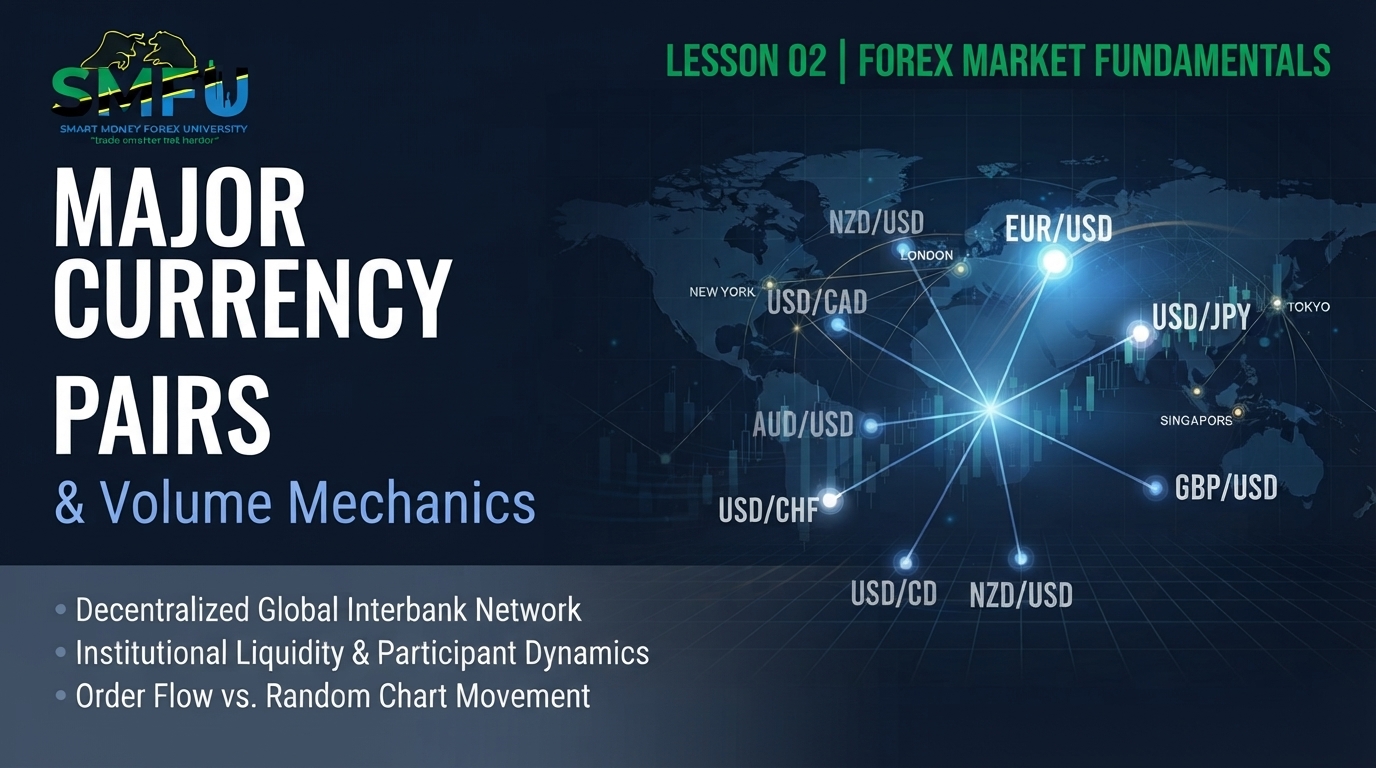
The Forex market is a decentralized global financial market. Transactions take place through a network of banks, financial institutions, brokers, liquidity providers, corporations, central banks, and other market participants.
This structure allows currencies to be traded across different financial centers around the world.
Major financial centers such as London, New York, Tokyo, and Singapore play important roles in global currency trading.
Because these financial centers operate across different time zones, the Forex market remains active throughout the working week, moving from one major financial center to another.
The Role of Banks and Financial Institutions
Large financial institutions play an important role in the Forex market.
Commercial banks may exchange currencies for their clients, manage their own currency exposure, or participate in the interbank market. Investment firms, corporations, hedge funds, and other institutions may also need to buy or sell currencies for different reasons.
For example, an international company may need to convert one currency into another to pay suppliers in a different country.
A financial institution may also need to manage exposure created by international investments or transactions.
These activities contribute to the enormous volume of currency transactions taking place every day.
Understanding Liquidity
One of the most important concepts in Forex is liquidity.
Liquidity refers to the availability of buyers and sellers who are willing to transact at or near current market prices.
When liquidity is high, large orders can generally be executed more efficiently because there are more participants on the other side of transactions.
When liquidity is lower, price can sometimes move more quickly because fewer orders are available at nearby price levels.
This is one reason why different trading sessions and currency pairs can behave differently at different times.
Order Flow and Price Movement
Every market transaction involves an interaction between buying and selling.
When market participants place orders, those orders interact with available liquidity. The resulting transactions contribute to changes in the market price.
This is where order flow becomes important.
Order flow describes the flow of buying and selling activity within a market. It does not mean that every price movement can be directly attributed to one institution or one specific order.
Instead, price reflects the combined activity of many participants interacting with available liquidity.
For a beginner, this distinction is important.
You may see a large movement on a chart, but the chart alone does not tell you exactly which institution caused that movement or what its intentions were.
Why Price Moves
Forex prices can move for many different reasons.
Economic data can change expectations about a country's economy.
Interest-rate expectations can influence how attractive a currency is to investors.
Central bank decisions can significantly affect currency valuations.
Market sentiment can cause traders and institutions to adjust their positions.
Institutional transactions and hedging activity can also contribute to price movement.
At the same time, the interaction between available liquidity and incoming orders influences how these changes are reflected in price.
This is why Forex price movement should not be viewed as the result of one simple factor.
The Importance of Market Participants
The Forex market contains participants with very different objectives.
A central bank may be focused on monetary policy and economic stability.
A commercial company may simply need to exchange currencies for international business.
An investment fund may be managing a portfolio.
A retail trader may be looking for a short-term trading opportunity.
These participants do not necessarily enter the market for the same reasons, and they do not operate with the same resources, information, or objectives.
Understanding this difference helps you develop a more realistic view of the market.
Why the Market Can Look Random
When beginners first look at a Forex chart, price movement can appear completely random.
One candle moves strongly upward. Another moves downward. Price breaks a level and then reverses. A trend continues for several hours and suddenly changes direction.
However, the fact that price can be difficult to predict does not mean that the market has no structure.
The market is responding continuously to new information, expectations, orders, liquidity, and changing market conditions.
The challenge for a trader is not to predict every movement.
The objective is to develop a framework for understanding what is happening and to manage risk when uncertainty remains.
A Professional Perspective
A professional approach begins with understanding that the chart is only the visible part of a much larger market.
What you see on the chart is the result of interactions taking place between different participants and different forces.
Instead of asking only:
“Where is price going?”
Begin asking:
What is causing this movement?
Who might be participating in this market?
Where is liquidity available?
What information is influencing expectations?
What has changed in the market environment?
These questions encourage deeper analysis and help you move beyond simply reacting to candles.
Key Points to Remember
The Forex market is a decentralized global financial market.
Banks, institutions, corporations, central banks, and retail traders all participate in the market.
Liquidity represents the availability of buyers and sellers around current prices.
Order flow reflects the interaction of buying and selling activity.
Price movement can be influenced by economic data, interest rates, central bank decisions, market sentiment, institutional activity, and liquidity conditions.
A chart shows the result of market activity, but it does not reveal every participant's intentions.
Understanding how the market works is more important than memorizing trading strategies.
Reflection
Before moving forward, take a moment to look at the Forex market differently.
A chart is not simply a collection of candles moving randomly across your screen.
Behind those candles is a global network of participants, transactions, expectations, and liquidity.
The more you understand what happens behind the chart, the easier it becomes to interpret what you see on the chart itself.
As you continue through the SMFU Forex Basics series, keep this question in mind:
What is happening behind the price movement I am seeing?
Next lesson: What is a Currency Pair? (Base vs Quote Explained)