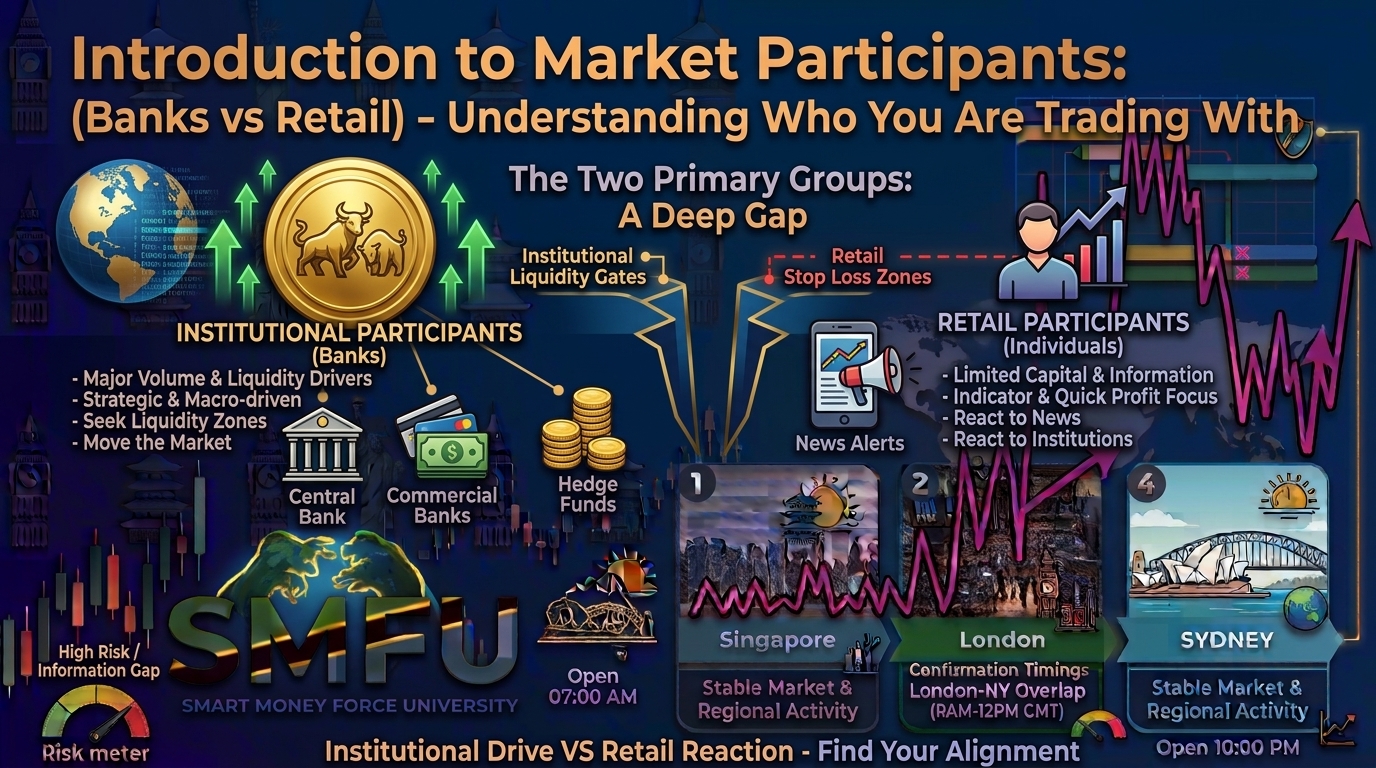
Introduction to Market Participants (Banks vs Retail)
Understanding Who You Are Trading With
The Forex market is not a single entity. It is a network of participants operating at different levels, each with its own objectives, resources, and influence.
To trade effectively, you must understand who is involved in the market and how their actions impact price movement.
Many beginners focus only on charts. Professional traders focus on participants behind the charts.
The Two Primary Groups
Although there are many participants in the Forex market, they can be broadly divided into two main groups:
Institutional Participants
Retail Participants
The difference between these two groups defines how the market behaves.
Institutional Participants
Institutional traders operate at the highest level of the market. This group includes:
Central banks
Commercial banks
Hedge funds
Large financial institutions
These participants control the majority of trading volume.
Their objectives are not always the same, but they often include:
Managing national economies
Facilitating international trade
Executing large investment strategies
Because of their size, institutions cannot enter or exit trades randomly. They require large amounts of liquidity to operate efficiently.
This is why their activity often shapes market direction.
Retail Participants
Retail traders are individuals trading through brokers. Their capital is relatively small compared to institutions.
Most retail traders:
Trade based on indicators or short-term signals
React to news after it is released
Focus on quick profits
While retail traders are numerous, their combined volume is still small compared to institutional activity.
This means they do not move the market. Instead, they react to movements created by institutions.
The Key Difference
The most important difference is not just capital—it is approach.
Institutions operate with:
Long-term planning
Access to deep market data
A focus on liquidity and execution
Retail traders often operate with:
Limited information
Emotional decision-making
A focus on outcomes rather than process
This difference creates a gap. Understanding this gap is essential for improving your trading.
Why Retail Traders Struggle
Many retail traders unknowingly place themselves on the wrong side of the market.
For example:
They place stop losses at obvious levels
They enter trades based on late signals
They follow patterns without understanding context
These behaviors create liquidity zones, which institutions use to execute their trades.
This is not manipulation in a simplistic sense. It is the natural function of a market driven by large orders.
A Professional Perspective
To develop as a trader, you must shift your mindset.
Instead of asking:
“What should I buy or sell?”
Start asking:
“What are institutions likely to be doing?”
“Where is liquidity located?”
“Who is on the other side of this trade?”
This perspective aligns you with the market rather than against it.
Key Points to Remember
The Forex market consists of institutional and retail participants
Institutions control the majority of market volume
Retail traders have limited influence on price movement
Institutions require liquidity to execute large trades
Retail behavior often creates liquidity zones
Success comes from aligning with institutional activity
Reflection
At this point, your understanding of the market is evolving.
Consider this:
If institutions drive the market and retail traders react to it, which side should you aim to align with?
This question is central to your development as a trader.
Next lesson: Forex Trading Sessions (London, New York, Asia)
Previous Lesson: What Moves the Forex Market? (Core Drivers)